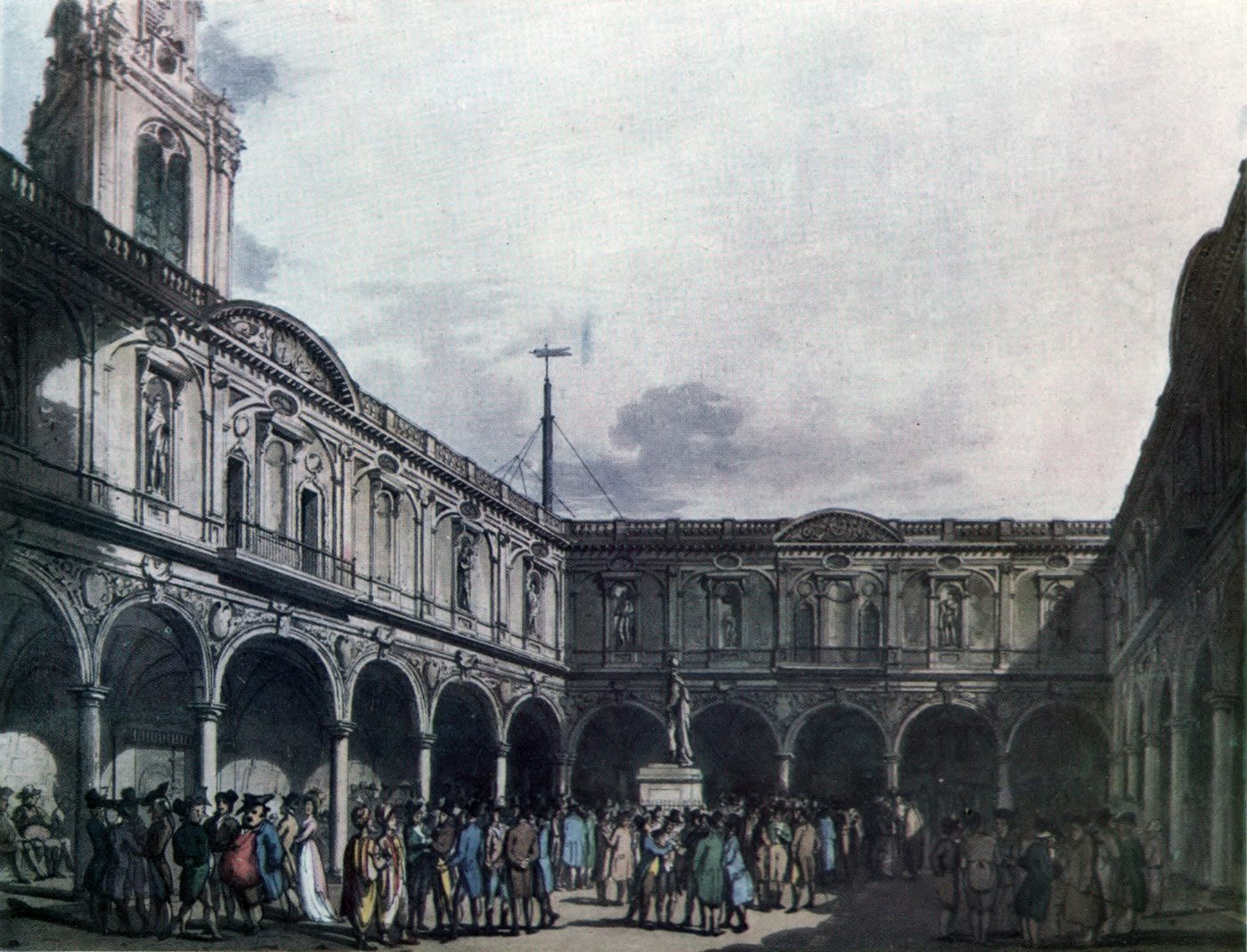
When Sir William Tite's building opened in 1844, its courtyard had no roof at all: trading happened outdoors, under London's own weather, for the better part of forty years. This chapter follows the Royal Exchange courtyard from that open-air arrangement to the Royal Exchange glazed courtyard roof merchants eventually got, and to what has covered it since. The change didn't come quickly: London's merchants had chosen to leave the space open when Tite's building went up, a decision the Royal Exchange courtyard in the 1880s would prove had been a mistake.
Forty Years Open to the Sky
London merchants had insisted on an open courtyard when the third Royal Exchange was designed, following the same layout every version of the building had used since 1571: an open trading floor at ground level, ringed by covered walkways. It was, by most later accounts, a decision they came to regret. Trading in bad weather meant getting rained on in the one place merchants most needed to stand and talk business, and by the 1870s calls to cover the space had grown hard to ignore.
The covered walkway around the edge offered some shelter, but the open middle, where most of the actual buying and selling happened, had none. On a wet afternoon, business either moved into the walkway's crowded margins or simply got wetter along with everyone conducting it. Almost forty years passed between the building's 1844 opening and the roof finally going up, long enough that the open courtyard had become simply how things were, however impractical, before anyone acted on it.
Royal Exchange Courtyard: The 1880s Glass Roof
The Royal Exchange courtyard finally got its glass roof in 1883, when an elaborate vaulted canopy of glass and cast iron was raised over the open trading floor. The new glass roof was designed by Charles Barry Jr, son of Sir Charles Barry, one of the five architects Tite had beaten in the 1839 competition for the building itself. Four decades after his father lost that contest, the younger Barry got to put his own mark on the same building.
The Royal Exchange courtyard in the 1880s took on the vaulted, glazed look many visitors still associate with the building, even though the roof standing today is a later replacement, not Barry's original. Contemporary accounts called the new canopy elaborate: an ornamental glass-and-ironwork ceiling that turned an open yard into a genuine atrium, sheltered at last from the weather that had troubled traders for forty years.
Charles Barry Jr and the New Atrium
Barry's atrium didn't just add a roof: it changed the courtyard's whole character. The new glass roof brought soft, filtered daylight down onto the trading floor rather than open sky, and the shift from an outdoor yard to a covered atrium is often the detail visitors remember best about the Royal Exchange courtyard today. Little of Barry's actual ironwork survives; the canopy over the courtyard now is a later, plainer design, though it keeps the same basic idea, a full, glazed ceiling over the same open rectangle Gresham first laid out in 1566.
Not everything above Tite's courtyard changed this often. His clock tower and its grasshopper weathervane, cast from Gresham's own crest, has stood over the building since 1844, through the courtyard's open years, Barry's 1883 canopy, and the roof that replaced it, the one part of the skyline the courtyard's own changes of roof never touched.
A Courtyard Rebuilt Twice More
Barry's 1880s roof lasted almost a century before it was replaced. In 1982, when the futures market LIFFE took over the courtyard as a trading floor, the by-then rotting Victorian roof was pulled out and a new one put in its place, along with two extra floors of office space. That roof came down too, in the full 2001 refurbishment that turned the whole ground floor into shops and restaurants, the retail space, still under its own glass roof, that visitors walk through today. This is the Royal Exchange glazed courtyard roof story in brief: from open sky, to Barry's 1880s canopy, to the glass ceiling overhead now.