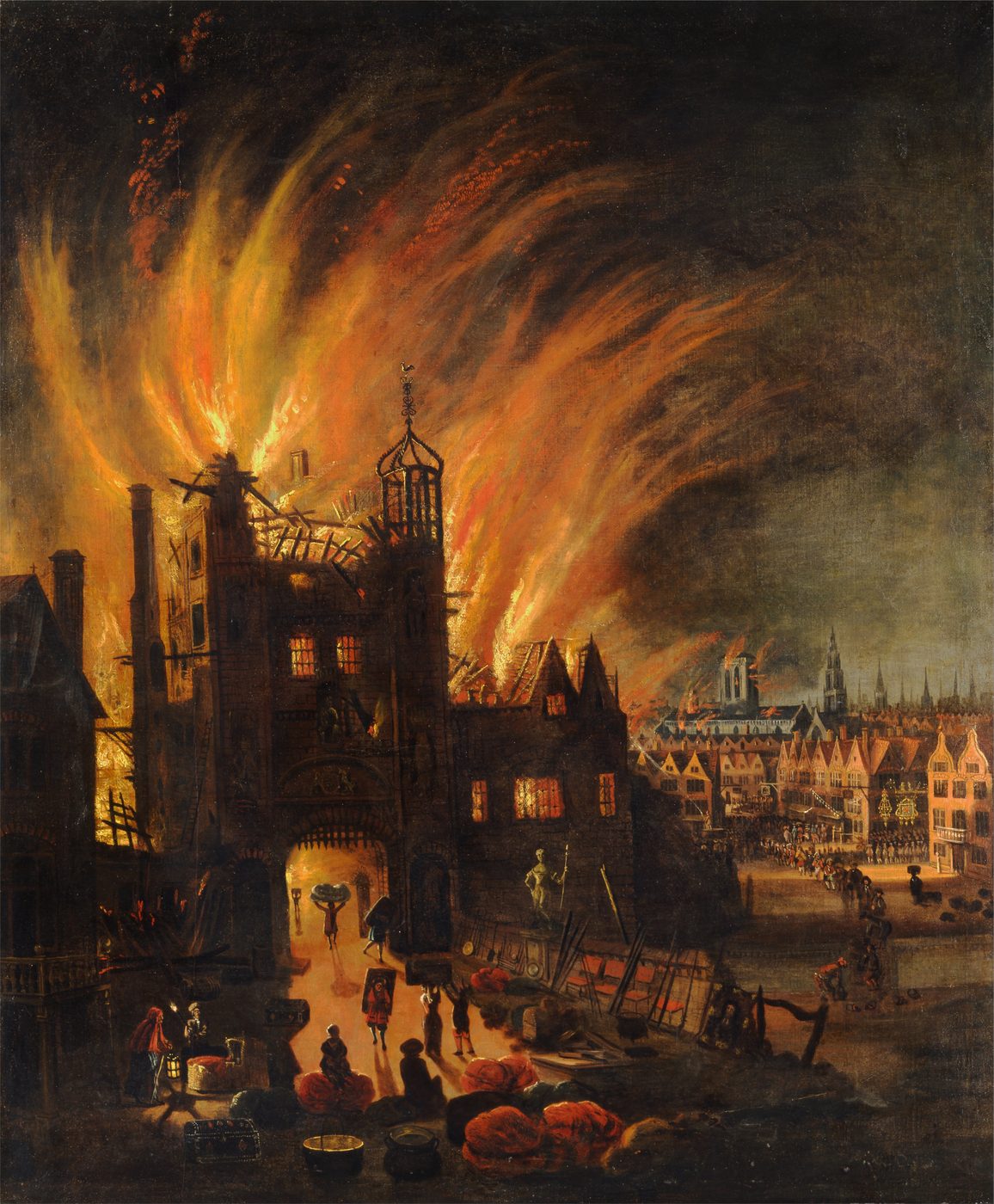
This is the Royal Exchange fire history in brief: not one blaze but two. Sir Thomas Gresham's original 1571 building, the one whose founding is covered elsewhere on this site, burned in the Great Fire of London, and the Royal Exchange after the Great Fire, a second building, burned again in 1838. Each fire cleared the ground for a new building on the same Cornhill site: the second designed by Edward Jerman, the third by Sir William Tite. This account of Royal Exchange fire history covers both losses, and how the City rebuilt after each one.
The Great Fire of London, 1666
Gresham's Royal Exchange stood for not quite a century before the Great Fire of London reached it. The fire started in a bakery on Pudding Lane on 2 September 1666 and burned for four days, destroying most of the medieval City. Among the losses were:
- Old St Paul's Cathedral: the medieval cathedral that stood before Wren's replacement.
- The Guildhall: the City of London's seat of government.
- Roughly 13,200 houses: across the walled City and beyond.
- 87 parish churches: most later rebuilt, many by Christopher Wren.
The Royal Exchange, built largely of timber behind its stone facade like most of its neighbours, was one of these losses. Nothing of Gresham's original 1566 building survived above ground.
Royal Exchange Fire: Rebuilt by Edward Jerman, 1669
Rebuilding began almost immediately. The City of London Corporation appointed Edward Jerman, the City's own surveyor, to design a second Royal Exchange in the years right after the fire. His Baroque-style building reopened to merchants in 1669, on the same Cornhill site as Gresham's original, and kept the same basic arrangement: an open courtyard for trading, ringed by a covered walkway and a gallery of shops above.
The Royal Exchange after the Great Fire looked different on the outside: grander, more classical in its detailing, with a taller central tower, but its purpose hadn't changed. Merchants and insurance underwriters conducted business from its courtyard and galleries, among them the marine insurers of Lloyd's, who moved into the building itself in 1774. It served as the City's trading floor for close to 170 years, long enough that few Londoners living through its final years would have remembered Gresham's original building at all.
Destroyed Again in 1838
Jerman's building lasted nearly 170 years, until the night of 10 January 1838, when a fire broke out in the rooms used by Lloyd's, the marine insurance market that by then traded from inside the Exchange. It is generally attributed to an overheated stove. It was one of the coldest nights of the year, and firefighters' hands reportedly froze to the pumps as they fought the blaze.
The building's clock tower kept striking the hour even as the fire consumed the floors beneath it, and the flames were said to be visible from Windsor, 24 miles away. By morning, the Royal Exchange destroyed in 1838 was little more than a shell, the second time in less than 200 years that the City had lost its trading hall to fire, and the second time a working exchange floor had to be found elsewhere while a replacement went up.
A Competition to Rebuild
A design competition to replace the Royal Exchange destroyed in 1838 opened the following year, 1839, but its first round produced nothing usable. The City then ran a second, invitation-only competition among five established architects:
- Sir William Tite: the eventual winner.
- Charles Robert Cockerell
- George Gwilt
- Sir Charles Barry
- Sir Robert Smirke
Tite's design won, and construction began soon after. That third building, the one still standing on Cornhill today, is where this history picks up next.