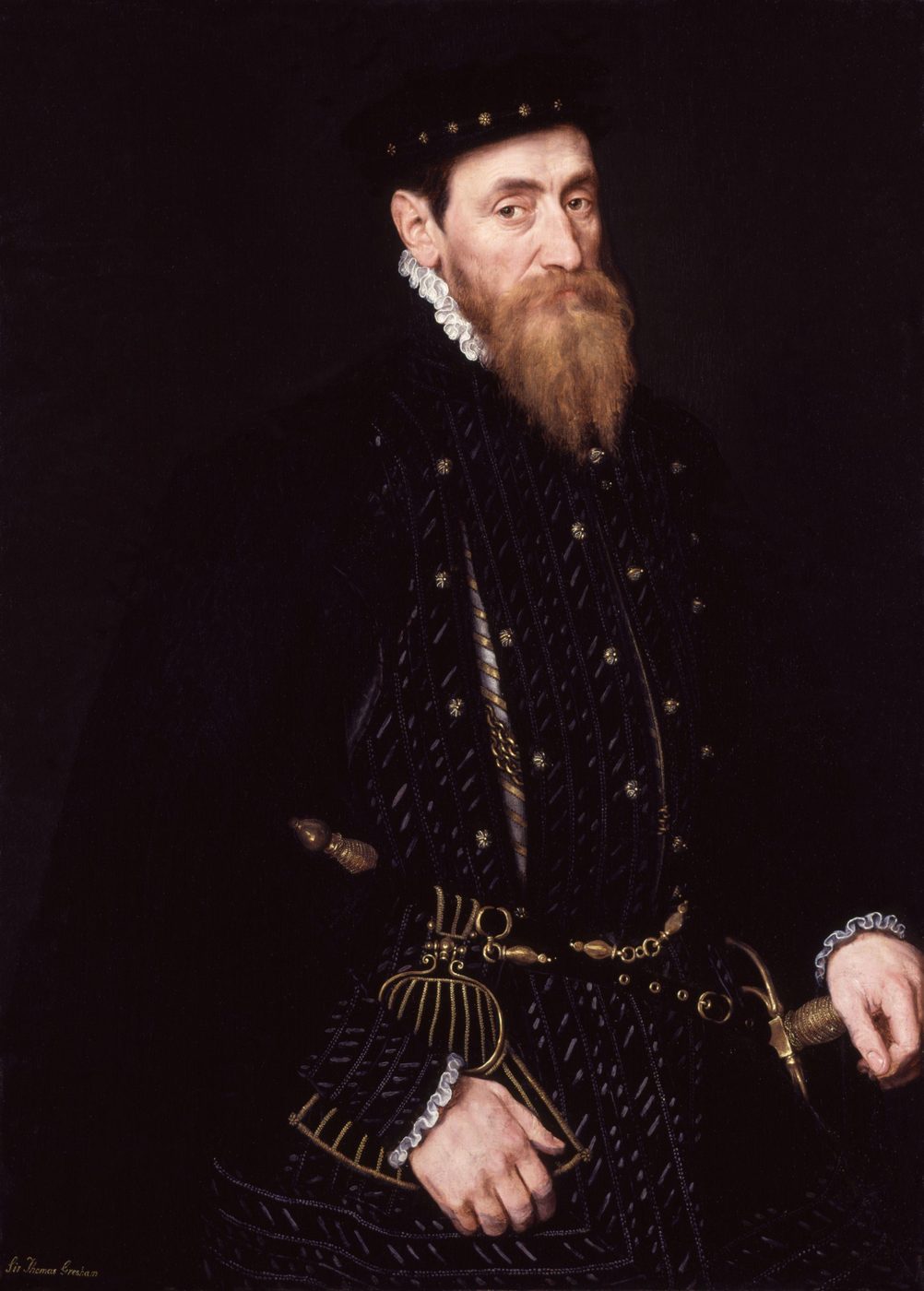
This is a short history of the Royal Exchange's founding, the London merchant hall that Sir Thomas Gresham built at his own expense, on a site the City of London had held since the Middle Ages. Elizabeth I opened it in person on 23 January 1571, and gave it the name it has carried ever since. What follows is the earliest chapter of Royal Exchange history: how one merchant's private venture became the City's most famous trading hall.
Thomas Gresham and the Antwerp Model
Thomas Gresham spent much of the 1540s working in Antwerp as a mercer and financier, and later served Elizabeth I as her agent in the Low Countries. There he came to know the Antwerp Bourse, a purpose-built hall where merchants of every trade gathered at fixed hours to do business, rather than striking deals outdoors in all weather. No equivalent existed in London: merchants still traded on Lombard Street, exposed to the rain regardless of the season.
Gresham decided to build one, and this early history of the Royal Exchange is really the story of his answer to that gap. He hired the Flemish architect Hendrik van Paesschen, who designed the new hall around the same quadrangle-and-cloister arrangement Gresham had admired in Antwerp: an open courtyard ringed by covered walks, rather than a single enclosed room.
Building in the City of London, 1566–1568
The City of London Corporation and the Worshipful Company of Mercers, of which Gresham was a liveryman, provided the site on Cornhill, the same junction the building still occupies today, where Cornhill meets Threadneedle Street. Gresham laid the first stone himself on 7 June 1566 and paid for construction outright, a four-storey building with each level given its own purpose:
- Ground floor: an open courtyard ringed by a covered walkway, where merchants met to trade.
- First floor: the Pawn, a long gallery of small shop units.
- Upper floors: attic rooms under the roof, used for storage.
To fill the Pawn before opening, Gresham reportedly went round the gallery's shopkeepers twice in a single day, offering each of them their first year rent-free if they would furnish and light their units in time. It worked: by the time the building opened, the Pawn was fully let.
Royal Exchange History: Elizabeth I Opens It in 1571
Construction was largely finished by 1568, but the Royal Exchange founded in 1571 is the date that stuck: it took until 23 January of that year for Elizabeth I to visit the finished building in person. She toured the gallery of shops, declared that it should be known as the Royal Exchange, and granted it a licence to sell alcohol on the premises.
It was the first purpose-built commercial exchange in England, and City merchants moved their trading indoors for the first time in the building's history. Six days a week, two one-hour trading sessions were called by a bell rung from the tower, a rhythm the building kept for close to three centuries, long after Gresham himself was gone.
Gresham's Grasshopper
Gresham's own merchant's mark, a grasshopper, was carved into the new building and mounted as a weathervane above its tower. It is the same emblem that still tops the Royal Exchange founded in 1571, more than four and a half centuries after Thomas Gresham's building first opened its doors. Gresham went on to leave much of his fortune, on his death in 1579, to found a public lecture institution in London that still bears his name.
Every element of the building visible today still traces back to that same opening day. This is Royal Exchange history at its most literal, one building whose story keeps adding chapters.
This early history of the Royal Exchange ends where the next one begins: within a century, the City would lose this same building to fire, twice.